
The conversation used to be simple. Buying software meant faster deployment, lower upfront cost, and someone else's problem when it broke. Building meant control, customization, and a multi-year engineering project that had a decent chance of never shipping.
AI changed that. Now, a small team (even a non-technical team with the right prompts) can produce working software in days rather than months. The "build" option has become significantly cheaper and faster, meaning a lot of leaders who should be buying are now building, and vice versa.
This article is not a pitch for either side. It is a framework for making a clear-eyed decision. It accounts for your team's actual capacity, your vendor's contract terms, and what happens two years from now when neither option looks exactly like it did on day one.
Start Here: What Problem Are You Actually Solving?
Before you evaluate cost, timeline, or vendor contracts, answer this: Is this software core to how you compete, or is it infrastructure that keeps the lights on?
If the software is core to your competitive advantage, building almost always deserves serious consideration. You want to own the thing that makes you better than your competitors. A logistics company that has built proprietary route optimization software does not hand that off to a vendor. A fintech that has built a risk-scoring model should not outsource its core IP. If the capability is what you sell, treat it accordingly.
If the software is infrastructure (payroll, document storage, scheduling, asset management) you almost certainly should buy. The goal is not to build a better payroll engine than ADP. The goal is to run payroll accurately, on time, and without your engineering team touching it. Infrastructure exists to support the business, not to differentiate it. Every hour spent building and maintaining this type of software is an hour not spent on the thing that actually makes you money.
If the answer is somewhere in between, that is where the rest of this framework applies. Keep reading.
Most leaders make their mistakes here, either they overbuild payroll type infrastructure because ownership feels like progress, or they outsource core capabilities because the vendor's demo was convincing and the contract looked manageable. Neither of those choices are advisable.
The Engineer Question: Who Actually Needs to Touch This?
AI has made it genuinely possible to build certain classes of software without engineering involvement. Tools like automation workflows, internal dashboards, basic data pipelines, lightweight client-facing tools. These are now realistic builds for a technical founder or a motivated team member with the right AI tools.
It is crucial to know, the size and complexity of the build is not the only variable.
If the software touches customer data, financial records, or anything regulated, engineering oversight is mandatory, it is liability management. AI-assisted code is not automatically secure code. It is not automatically compliant code. And it does not automatically behave correctly at scale.
An honest test: if this software failed for 48 hours, what would break? If the answer is "not much," you may have room to build without deep engineering involvement. If the answer is "we would lose customer data, miss a regulatory filing, or blow a revenue target," you need engineers reviewing the architecture before anything goes into production.
Pulling engineers away from your core product to build internal tooling is a real cost that rarely appears in the build vs. buy analysis. Their time has an opportunity cost. If your engineering team is three people and you redirect one of them for two months to build an internal workflow tool, you have just traded two months of product velocity for a tool you could have purchased for less than their two month salary.
The Cost Comparison That Most Leaders Do Wrong
When leaders compare build vs. buy costs, they typically compare the vendor's annual contract price against the engineering hours to build. That is incomplete in two important ways.
On the build side, you are not only paying for the initial build. You are paying [in time & money] for maintenance, security updates, bug fixes, and the ongoing cost of someone owning that system whenever something breaks. Software that is not actively maintained degrades. Dependencies become outdated. Integrations break when a third-party API changes. The up front build cost is a fraction of the total cost of ownership.
On the buy side, you are paying for more than the sticker price. You are paying for the full term of the contract, including any renewal pricing escalations, overage charges, and the switching cost when/if you move to a different vendor.
If a vendor's price seems unreasonably high relative to what you are getting, run a real build analysis. High price plus high switching cost plus hostile contract terms is when building becomes attractive.
The Contract: What You Are Actually Agreeing To
Most build vs. buy decisions treat the vendor contract as an afterthought. It should not be. The contract is where you find out whether the price you are paying is actually the price.
Before signing, here are terms for your consideration:
Auto-renewal window and renewal pricing lock. Many SaaS contracts auto-renew within a 30-to-60-day window. If you miss it, you are locked in for another year. More importantly, if renewal pricing is not capped in the contract, your second-year cost could be materially higher than your first. Negotiate a price lock or a cap on annual increases before you sign.
User seat limits and true-up pricing. If your team grows, what happens? Many contracts include true-up provisions that allow the vendor to retroactively charge for users above the licensed count (often at full list price, with no negotiation). Understand this before you scale.
Uptime SLA and support tiers. A 99.9% uptime guarantee sounds strong until you read the credit claiming process. Most SLA credits are capped at a small percentage of monthly fees and require the customer to proactively file a claim. If the software is mission-critical, make sure the SLA has real teeth or negotiate enhanced support terms.
Data portability and deletion timelines. If you leave, what happens to your data? Can you export it in a usable format, or does it live in a proprietary schema that makes migration expensive? Is there a defined deadline for data deletion after termination? These terms directly affect your ability to switch vendors and your data compliance obligations.
Termination for convenience. Can you leave before the contract ends, and at what cost? Many enterprise SaaS contracts do not include termination for convenience. This meass you are committed for the full term regardless of performance. If this clause is absent, the contract should reflect that in a lower price or a shorter initial term.
Unilateral contract modification clauses. This is the term most leaders overlook. Some vendors reserve the right to change pricing, features, or terms with 30 days' notice. If a vendor will not remove or narrow this clause, treat it as a significant risk factor in your build vs. buy decision.
Data training provisions. Read the data handling section carefully. Some vendors include language that permits them to use your data to train their AI models. If your data is proprietary, competitive, or sensitive, this clause should be a hard stop. Negotiate it out or treat it as a disqualifying term.
These are not weird edge cases. These are common provisions that appear in most SaaS contracts, and they are negotiable more often than vendors want you to believe.
The Build vs. Buy Decision Table
Use this as a working reference, not a rigid scorecard. The right answer depends on your specific context, but these signals should move you in a clear direction.
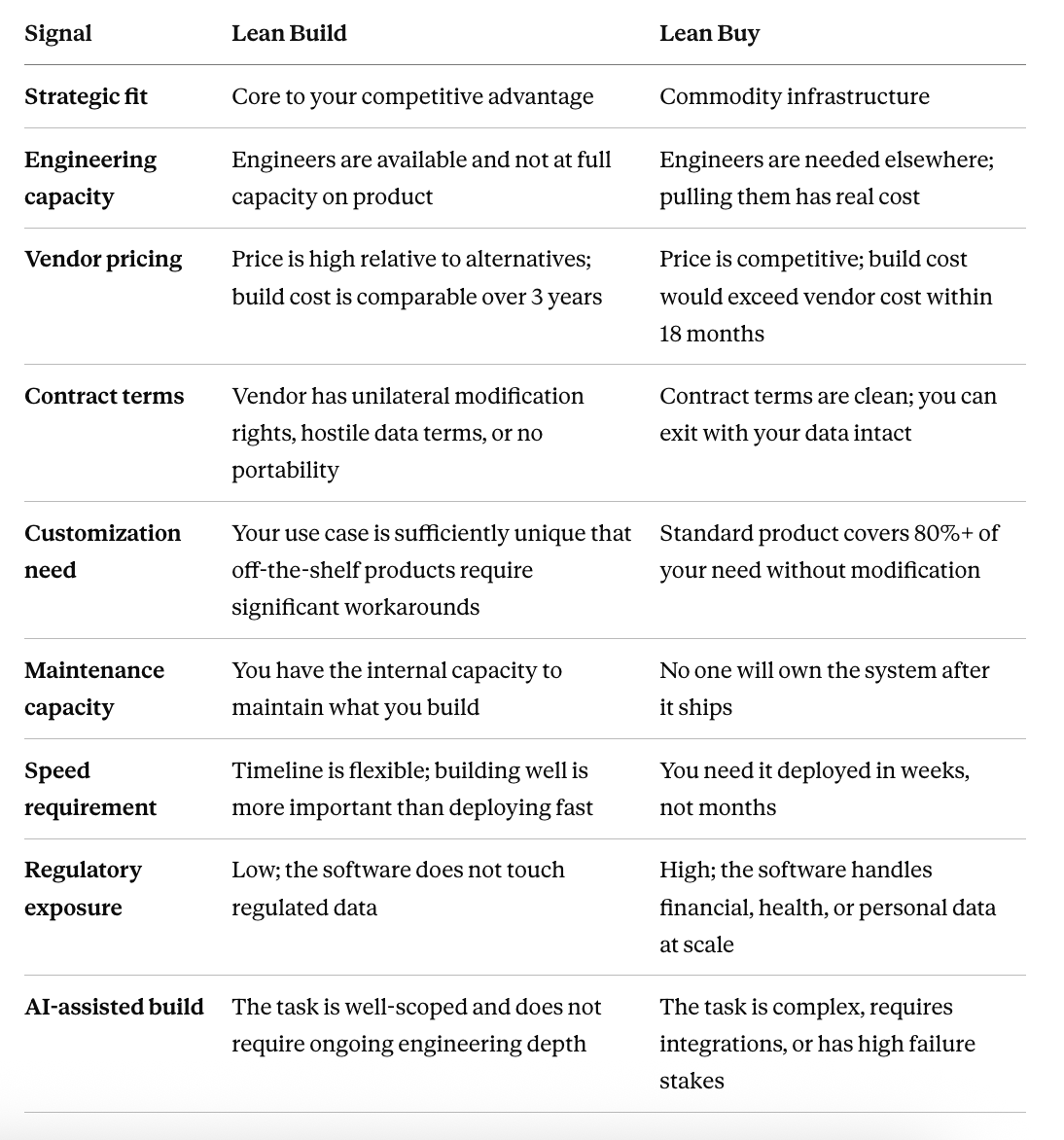
What Happens After You Build
AI-assisted builds can ship fast. But a product shipping is not the same as a product being maintained. Six months after your team builds an internal tool with AI assistance, you will have a codebase that someone needs to own. Dependencies will need updating. Edge cases will surface. The integration that worked when you had 50 users may not work at 500.
Before you commit to building, answer these questions:
Who owns this after it ships?
What is the plan when it breaks at 11pm on a Friday?
How will it be updated when a dependency becomes deprecated or a security vulnerability is found?
Does your team have the capacity to maintain this alongside everything else they own?
If you cannot answer those questions clearly, buying may be the better option. The vendor's software is not inherently better, but ownership without maintenance capacity is a powder keg waiting to explode.
The Decision, Simplified
If the software is core to how you win, the vendor's contract terms are hostile, and you have the engineering capacity to build and maintain it…build.
If the software is commodity infrastructure, the vendor offers clean terms with real data portability, and pulling engineers would cost you more in product velocity than the contract costs in dollars…buy.
Most decisions live somewhere between those poles. The table above will help you find where yours sits. Most importantly do not let price be the only filter. Start with strategy, work through capacity, and then read the contract before you sign anything.
The right decision is the one you will not regret in year three.
If you're in the middle of a vendor evaluation, ParaClause offers a free contract scan that flags the terms worth negotiating before you sign. No obligation, just clarity before you commit.